
Stay Rooted In God

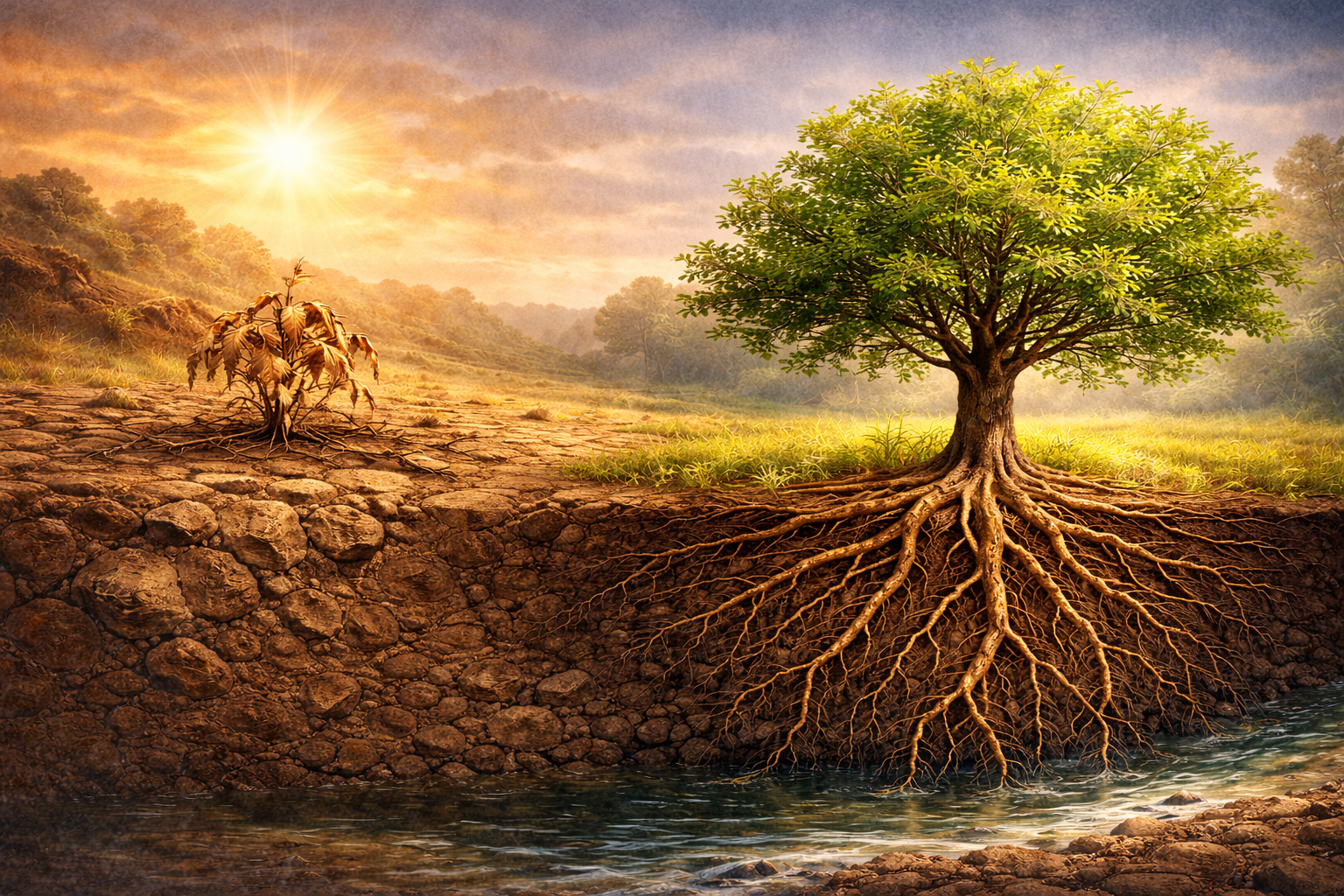
But when the sun came up, the plants were scorched, and they withered because they had no root. -Mark 4:5–6, NIV.
The Gospel of Mark 4:5–6 is part of Jesus’ Parable of the Sower, in which He describes how seeds fall on different types of soil, representing different responses to God’s word. The seed that falls on rocky ground grows quickly because the soil is shallow, but it soon withers when the sun rises because it has no deep roots. Jesus later explains that this represents people who initially receive God’s word with joy, but their faith is shallow. When difficulties, pressure, or persecution arise, they fall away because their spiritual foundation is not deep.
The roots of a plant are hidden beneath the soil, unseen but essential to its survival. Though they remain out of sight, they perform vital functions that sustain the life of the plant. Roots grow deep into the ground and spread outward, anchoring the plant firmly while absorbing and transporting water and nutrients from the soil. These nutrients nourish the entire plant and enable it to grow.
Without strong roots, even a healthy-looking plant cannot endure difficult conditions. On the surface, two plants may appear similar, but the differences become evident as the sun gets hotter or the soil dries. The plant with deep roots continues to stand because it draws life from beneath the surface, while the plant with shallow roots soon withers. In many ways, the depth of the root determines the plant’s strength and endurance. This picture helps us understand an important aspect of our spiritual lives. What sustains us through the changing seasons of life is not merely what others see on the surface, but the depth of our connection with God and His word. When we are firmly rooted in Him, we have a source of strength that remains steady even when circumstances around us are uncertain.
Life inevitably brings moments of challenge. There are seasons of abundance and seasons of scarcity, times of clarity and times of confusion. In those moments, our stability is not determined solely by external conditions but by the foundation upon which our lives are built. Being rooted in God means drawing our strength from Him in every season.
An example of someone who remained rooted in God in a difficult time is Isaac. In the Book of Genesis, chapter 26, we are told that a famine had come upon the land. Famine was a serious crisis in the ancient world because it threatened livelihoods, food supply, and survival. In times like these, people often moved elsewhere in search of better conditions.
Isaac considered leaving the land and going down to Egypt, which was often a place where people sought refuge during famine. However, God appeared to him and gave him a specific instruction:
Do not go down to Egypt; live in the land where I tell you to live. Stay in this land for a while, and I will be with you and will bless you.– Genesis 26:2–3, NIV.
From a practical perspective, remaining in a land suffering from famine may not be the most reasonable decision. Yet Isaac chose to listen to God and remain where he was. His decision reflected a posture of trust; trust rooted in God and in the conviction that His word was worth obeying, even when the circumstances around him seemed discouraging. This story invites us to reflect on our own lives. How often do we hear God’s prompting but hesitate because it does not align with what seems most sensible at the moment? Sometimes we receive guidance through Scripture, prayer, or wise counsel, yet we struggle to follow through because the path ahead looks uncertain.
Remaining rooted in God often requires us to trust Him beyond what we can immediately understand. It does not mean ignoring wisdom or circumstances, but it does mean acknowledging that God’s perspective is greater than our own.
Isaac not only stayed in the land as God instructed, but he also continued his work as a farmer. Despite the famine, he planted his crops and carried on with his responsibilities. The Scripture records what happened next:
Isaac planted crops in that land and the same year reaped a hundredfold, because the Lord blessed him. – Genesis 26:12, NIV.
The focus of this passage is not simply the harvest Isaac received, but the faithfulness that guided his actions. Isaac remained where God had placed him and continued the work before him. His obedience did not come from a guarantee of results but from a willingness to trust God’s direction.
There are moments in life when obedience requires patience. Sometimes the outcome of our faithfulness is not immediately visible. Yet remaining rooted in God helps us remain faithful even when the season is difficult.
Throughout Scripture, the image of a tree with deep roots is often used to describe those who trust in God. The prophet Jeremiah writes:
But blessed are those who trust in the Lord and have made the Lord their hope and confidence. They are like trees planted along a riverbank, with roots that reach deep into the water. Such trees are not bothered by the heat or worried by long months of drought. Their leaves stay green, and they never stop producing fruit. – Jeremiah 17:7–8, NLT
This passage does not suggest that heat or drought will never come. Instead, it highlights the stability that comes from being connected to a constant source of life. A tree planted near water can endure difficult seasons because its roots reach the stream that sustains it. Similarly, when your life is rooted in God, you will be sustained by His presence and guidance even in challenging circumstances. Our confidence rests not in the absence of difficulty but in the One who remains faithful through every season.
This truth is also reflected in a popular hymn my mother loved:
In times like these, you need a Saviour,
In times like these, you need an anchor.
Be very sure, be very sure,
Your anchor holds and grips the Solid Rock.
The imagery of an anchor reminds us that stability does not come from calm waters alone but from being securely connected to something strong and dependable. God is that firm foundation.
Jesus expressed this truth beautifully in the Gospel of John when He said:
I am the vine; you are the branches. If you remain in me and I in you, you will bear much fruit; apart from me, you can do nothing. – John 15:5, NIV
A branch does not produce life on its own. It draws its life from the vine to which it is connected. In the same way, our spiritual vitality flows from our relationship with Christ. When we remain connected to Him, we receive the nourishment we need to grow and to live faithfully.
Being rooted in God is therefore not merely about what we might gain from Him. It is about living in a relationship with the One who created us and sustains us. Trusting Him shapes our choices, our priorities, and the way we respond to life’s circumstances. The seeds that God has placed within each of us, our gifts, opportunities, and calling, are part of His larger purpose. As we remain rooted in Him, we continue to grow and mature in ways that reflect His grace.
So cultivate the soil of your heart. Spend time nurturing your relationship with God through prayer, meditation, and obedience to His Word. Allow your roots to grow deeper in Him. And in every season, whether times of abundance or times of uncertainty, remain firmly rooted in God, who continues to be our source, our strength, and our sustaining foundation. Amen.
This Article was adapted from the Book Sow Your Seed